
Challenges in India’s School Education System
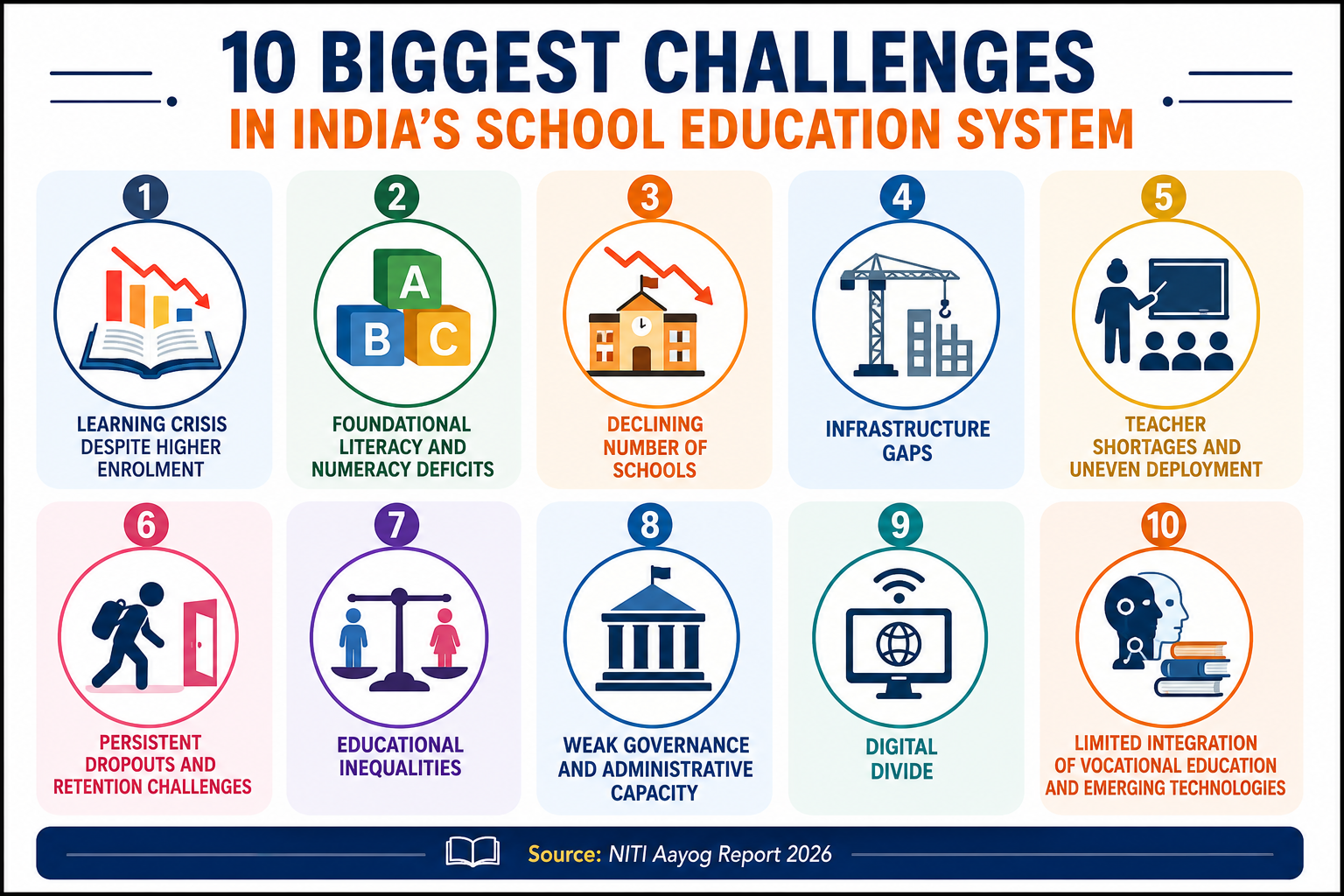
The NITI Aayog Report 2026 highlights the major challenges in India’s school education system, including learning gaps, teacher shortages, and infrastructure deficits.
Based on the Official – NITI Aayog Report – School Education System
India has made remarkable progress in expanding access to education over the last decade. According to the NITI Aayog report: “School Education System in India: Temporal Analysis and Policy Roadmap for Quality Enhancement (2026)”, the country now has 14.71 lakh schools, 24.69 crore students, and over one crore teachers (Page 14). However, despite these achievements, several challenges continue to hinder the delivery of quality and equitable education. The report identifies critical issues that need urgent attention to achieve the vision of Viksit Bharat@2047.
The 10 Biggest Challenges Facing India’s School Education System
1. Learning Crisis Despite Higher Enrolment
India has achieved near-universal access to elementary education, but many students still struggle to attain age-appropriate learning outcomes, particularly in reading and mathematics. The report stresses that improving learning quality is now more important than merely increasing enrolment (Pages xxii-xxiii).
2. Foundational Literacy and Numeracy Deficits
A large number of children continue to face difficulties in acquiring basic reading and numeracy skills. The report identifies Foundational Literacy and Numeracy (FLN) as the most critical educational priority and recommends sustained interventions beyond Grade 3 (Page xxv).
3. Declining Number of Schools
The number of schools in India declined from 15.58 lakh in 2017-18 to 14.71 lakh in 2024-25 due to school rationalisation and consolidation (Page 15). While intended to improve efficiency, this trend raises concerns regarding accessibility in remote and underserved areas.
4. Infrastructure Gaps in Schools
Many schools continue to face shortages of essential facilities, including digital infrastructure, libraries, laboratories, and resource centres. The report recommends universal access to foundational and digital infrastructure to improve educational quality (Page xxiv).
5. Teacher Shortages and Uneven Deployment
Teacher vacancies, multi-grade teaching, and uneven deployment remain major concerns. The report calls for better workforce planning, transparent recruitment, and continuous professional development for teachers (Page xxiv).
6. Persistent Dropouts and Retention Challenges
Dropout rates continue to be a challenge, particularly at the secondary and higher secondary levels. Children from disadvantaged backgrounds and migrant communities are especially vulnerable to discontinuing their education (Page xxv).
7. Educational Inequalities
Despite significant progress, disparities based on gender, socio-economic status, disability, and geographical location continue to affect educational outcomes. The report recommends targeted interventions for socially and economically disadvantaged groups (Pages xxiv-xxv).
8. Weak Governance and Administrative Capacity
The report highlights the need to strengthen governance structures, improve school leadership, and enhance administrative capacity at various levels of the education system (Page xxiv).
9. Digital Divide
The unequal availability of digital infrastructure and internet connectivity has created significant disparities in access to technology-enabled learning. The report advocates for the expansion of digital and broadcast-based education to ensure inclusive learning opportunities (Page xxiv).
10. Limited Integration of Vocational Education and Emerging Technologies
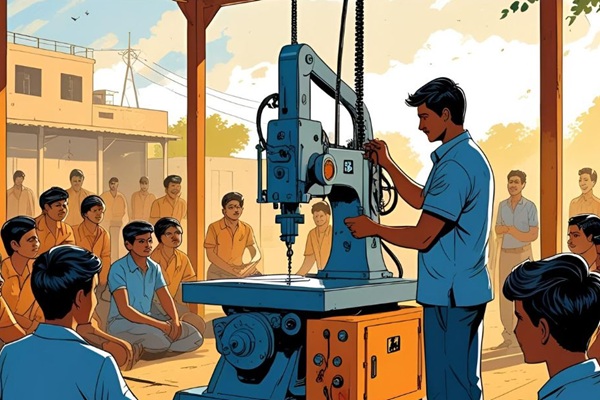
Although the National Education Policy 2020 promotes vocational education and the integration of Artificial Intelligence in schools, implementation remains limited. The report recommends mainstreaming vocational education and adopting emerging technologies to prepare students for future careers (Page xxv).
Also Read – Vocational Education – Its Systemic and Structural Barriers in India
The Way Forward
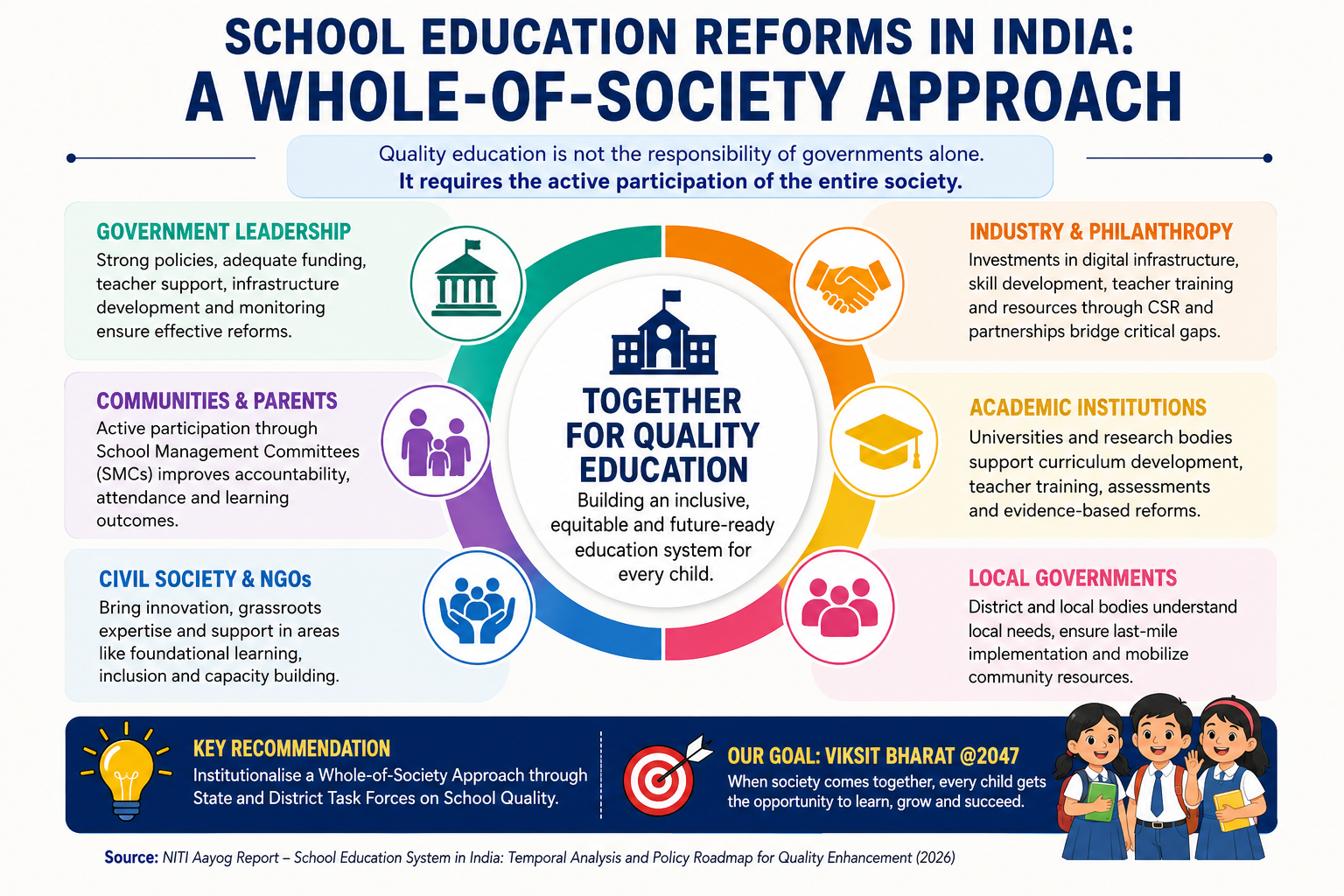
The NITI Aayog report emphasises that addressing these challenges requires a comprehensive and collaborative approach involving governments, communities, civil society, industry, and educational institutions. Improving educational quality, strengthening governance, supporting teachers, and ensuring equitable access to learning opportunities will be essential to transforming India’s school education system.
Conclusion
The Challenges in India’s School Education System extend beyond infrastructure and enrolment numbers. The real task lies in ensuring that every child receives quality, inclusive, and future-ready education. The NITI Aayog report provides a clear roadmap for reforms and highlights the urgent need to address learning gaps, teacher shortages, inequalities, and governance issues to build a stronger education system for the future.