
School Education Reforms in India: A Whole-of-Society Approach
Explore School Education Reforms in India and why the NITI Aayog advocates a Whole-of-Society Approach to achieve quality, inclusive, and future-ready education.
Based on the Official – NITI Aayog Report – School Education System
School Education Reforms in India have become central to the country’s vision of building a developed nation by 2047. The NITI Aayog’s 2026 report highlights that while India has expanded access to education significantly, achieving quality and inclusive learning requires a Whole-of-Society Approach, with governments, communities, industry, and civil society working together to transform school education.
As India seeks to transform its education system and achieve the goals of Viksit Bharat@2047, the NITI Aayog report emphasises that meaningful and lasting reforms can only be achieved through collective action. The need for a Whole-of-Society Approach is therefore more important than ever.
The report explicitly states:
“Quality education must be seen not merely as a sectorial responsibility, but as a societal mission.” (Page xxiii)
School Education Reforms in India Need Collective Action
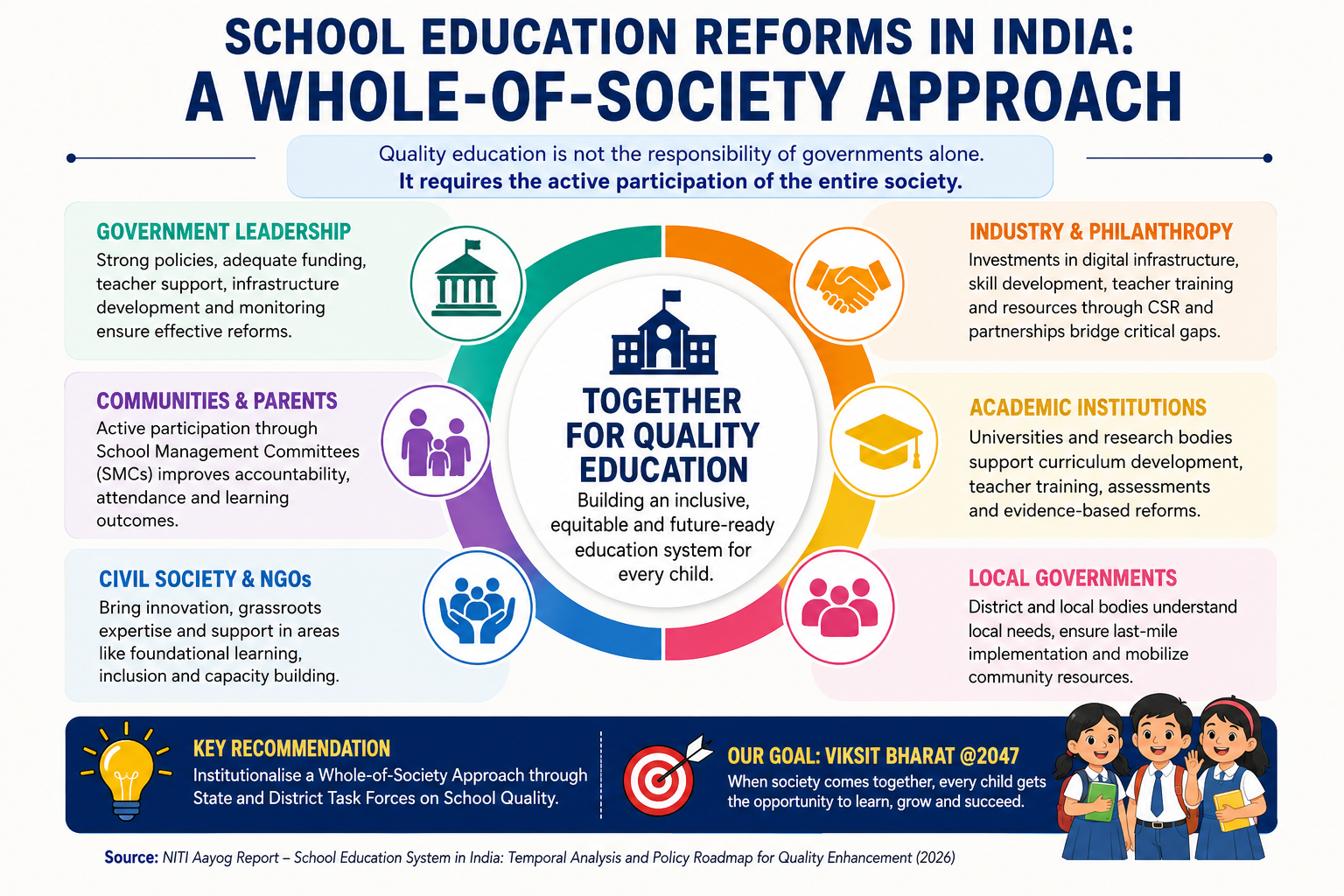
The NITI Aayog report notes that improving education cannot remain the sole responsibility of governments. The scale and diversity of India’s education system require participation from all stakeholders to address local challenges and improve educational outcomes (Pages xxiii-xxiv).
Community Participation for Better Schools
The report recommends strengthening School Management Committees (SMCs) and promoting bottom-up planning to improve accountability and community ownership of schools. Active involvement of parents and local communities can help improve attendance, infrastructure, and school governance.
Community participation can help in:
- Monitoring school functioning.
- Improving accountability.
- Increasing student attendance.
- Supporting infrastructure development.
- Mobilising local resources and expertise.
Role of Industry and Civil Society
The report highlights the need for greater investments in digital infrastructure, laboratories, libraries, teacher training, and vocational education (Pages xxiv-xxv). Industries and philanthropic organisations can support schools through CSR initiatives, technology partnerships, and skill development programmes. Similarly, NGOs and development partners can contribute through innovative solutions in foundational learning and inclusive education (Pages 10-11).
Improving Learning Outcomes Together
Despite improvements in enrolment, learning gaps continue to remain a major concern. The report stresses the importance of collaborative efforts such as community libraries, volunteer tutoring, alumni mentoring, and digital learning initiatives to improve learning outcomes (Page xxii).
Institutionalising a Whole-of-Society Approach
One of the key recommendations of the report is to “Institutionalise a Whole-of-Society Approach through State and District Task Forces on School Quality” (Page xxiv). These task forces would bring together government agencies, academic institutions, community representatives, civil society organisations and industry partners to improve school quality.
Conclusion: School Education Reforms in India Require Shared Responsibility
The report concludes that incremental reforms will not be sufficient to achieve the aspirations of Viksit Bharat@2047. Instead, India requires a system-wide transformation of school education, supported by a shared sense of purpose and coordinated action by all stakeholders.
The vision of Viksit Bharat@2047 can only be achieved through strong and inclusive School Education Reforms in India. The NITI Aayog report makes it clear that educational transformation is a shared responsibility. By bringing together governments, communities, industries, and civil society, India can build an education system that ensures quality learning and equal opportunities for every child.